UI/UX Design Trends for 2026: The
Rise of Spatial Intelligence
As we approach 2026, the boundaries between physical environments and digital
interfaces are dissolving. The era of the flat screen is giving way to a multi-dimensional
ecosystem where spatial awareness, cognitive offloading, and tactile feedback define the
user experience. ARCHFUTUR examines the three pillars of this coming shift.
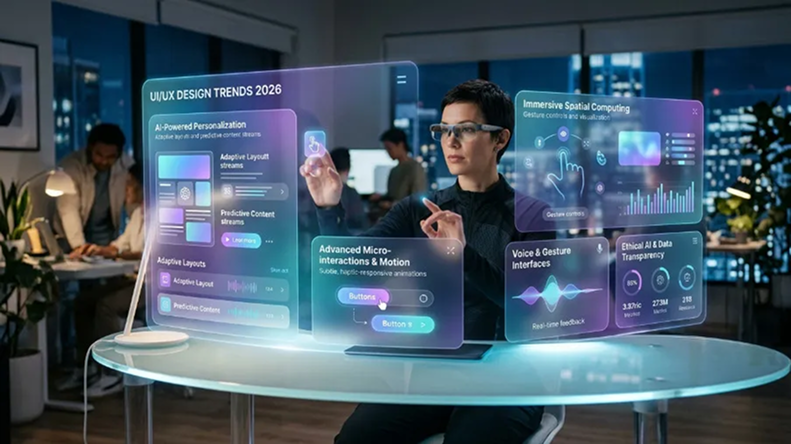
1. Spatial Computing & Depth Perception
Spatial interfaces are no longer confined to headsets. We are seeing a "spatialization" of 2D screens through high-fidelity glassmorphism and light neumorphism. This involves using physical properties like gravity, refractive index, and translucency to create an hierarchy that feels intuitive.
In 2026, depth is the new color. Elements don't just sit "on top" of each other; they float in a simulated 3D environment, casting soft, dual-toned shadows that help users understand context without cognitive strain.
2. Cognitive Design: The Lean-Back Experience
Designers are shifting away from "attention-grabbing" patterns toward "calm technology." Cognitive design focuses on reducing the mental load required to complete tasks. This means interfaces that anticipate user intent through ML-driven spatial layouts.
The "Lean-Back" experience prioritizes accessibility and focus. Large-scale blurred gradients and minimalist canvases (like the one you are reading now) are becoming standard for technical documentation and high-level strategy reports, allowing the content to breathe.
"The most profound technologies are those that disappear. They weave themselves into the fabric of everyday life until they are indistinguishable from it." — Mark Weiser
3. Tactile Glassmorphism
We are moving beyond simple transparency into "Tactile Glassmorphism." This involves simulating different materials—frosted glass, brushed gold, and polished stone—within digital interfaces. These materials react to user interactions with micro-vibrations and subtle lighting changes.
Gold accents, as seen in the ARCHFUTUR visual identity, serve as "interactive beacons." These aren't just decorative; they indicate primary action paths and high-value data points in a sea of minimalist sage and white.